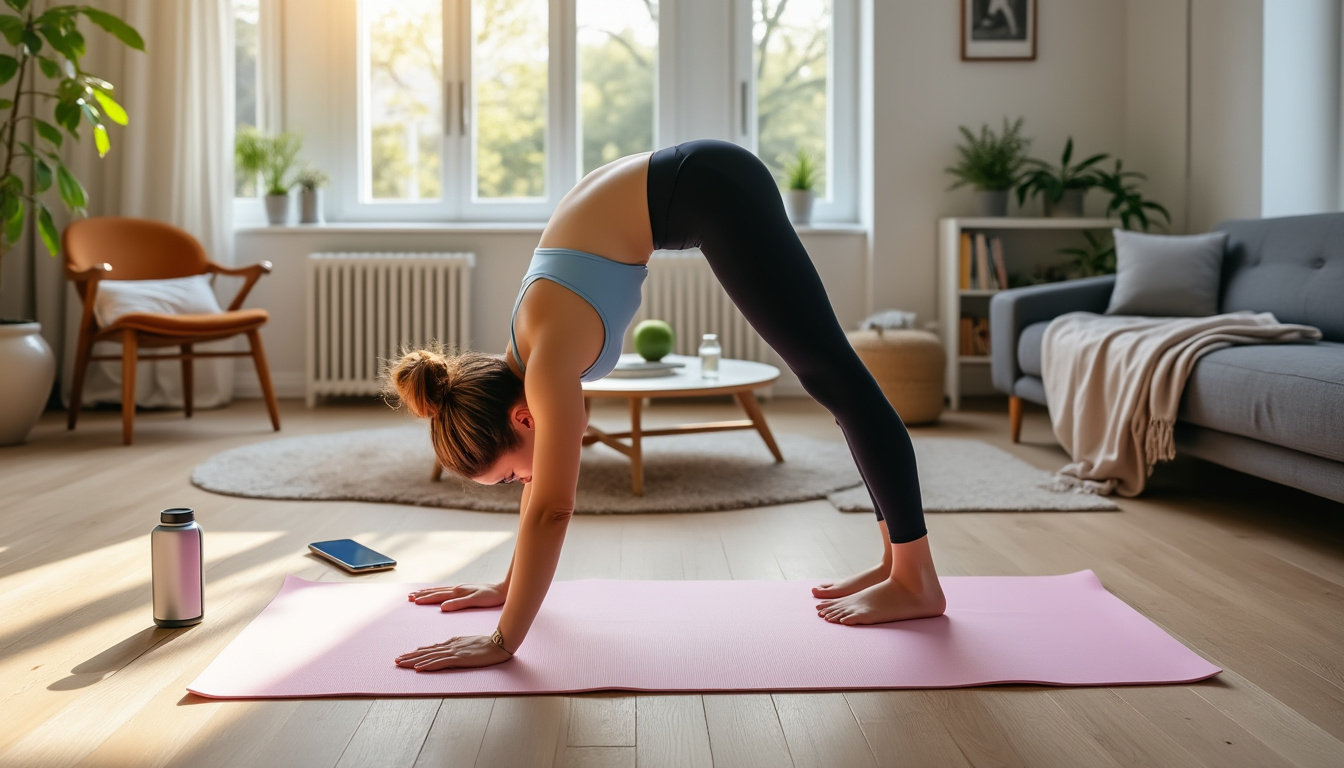
Starting yoga at home can seem intimidating, but a short, regular, and well-thought-out routine is enough to establish the habit. Claire, a busy 38-year-old executive, transformed her living room into a practice corner in fifteen minutes a day: breathing, back mobility, a few simple postures, and a short relaxation. In a few weeks, she experienced less lumbar tension, improved sleep, and better posture at the office. This text explains how to start beginner yoga at home without expensive equipment, what movements to protect, and which sequences to choose to progress without pain. You will find a ready-to-use 15-minute routine, accessible variations, a summary table of 10 useful routines for different objectives, as well as practical tips for creating a sustainable habit. Each section offers immediate actions to test today so that the practice becomes simple and lasting.
In short:
- Short and stable routine: 15 minutes are enough to get started.
- Safety first: moderate intensity (4–5/10), variations and stop if there is sharp pain.
- Minimal equipment: mat, blanket, cushion, and a chair if needed.
- Focus: breathing, back mobility, simple postures, relaxation.
- Regularity > duration: better to have 10 daily minutes than an occasional hour.
Why start beginner yoga at home: benefits and challenges
The benefits of yoga are numerous: improved mobility, reduced stress, better sleep quality, and core strengthening. For a beginner, the main interest is to restore functional movement and learn to breathe in connection with the body.
Practicing at home facilitates regularity as it reduces logistical barriers (travel, class schedule). However, care must be taken with precautions: chronic pain, heart symptoms, pregnancy, or recent injury require medical advice or guidance from a trained teacher.
To deepen the basic postures and their variations, a practical guide can be helpful: for example, consult the postures to start at home and simple routines explained step by step on routines suited for yoga at home. Insight: starting slowly protects more than chasing performance.
Beginner yoga routine: 15-minute plan to start yoga at home
A short and reproducible routine is the best entry point. Here is a simple 15-minute model designed to mobilize the back, open the hips, and calm the nervous system.
- 2 minutes: simple sitting and observing the breath (8–10 breaths).
- 5 minutes: round back/flat back mobilizations and adapted child’s pose (8–12 cycles and 5 breaths).
- 6 minutes: sequence of postures (low lunge, adapted downward dog, mountain, forward half-fold).
- 2 minutes: short lying relaxation to rest the body.
If you only have 5 minutes, keep the breathing, 1 minute of back mobilization, and a resting posture: that is enough to maintain continuity.
Practical tip: keep effort at 4–5/10; prefer to reduce the amplitude rather than forcing.
Summary table of 10 useful routines to start
| Number | Yoga Routine | Duration | Main Objective |
|---|---|---|---|
| 1 | Modified Sun Salutation | 10 min | Warm-up & energy |
| 2 | Breathing and relaxation | 15 min | Stress reduction |
| 3 | Gentle morning stretches | 10 min | Muscle awakening |
| 4 | Back relief | 15 min | Lower back tension |
| 5 | Yoga before sleep | 20 min | Preparation for sleep |
| 6 | Hip opening | 15 min | Pelvic mobility |
| 7 | Gentle core strengthening | 15 min | Core stability |
| 8 | Concentration and balance | 10 min | Mental anchoring |
| 9 | Chair yoga | 15 min | Accessibility |
| 10 | Complete recovery | 20 min | Deep relaxation |
Insight: vary according to the day’s needs, but maintain a basic repeated sequence.
Simple postures and beginner stretches, explained step by step
Here are the most useful postures for beginner yoga: simple sitting, round back/flat back, adapted child’s pose, low lunge, adapted downward dog, mountain, forward half-fold, lying relaxation. Each can be adapted with props or a chair.
- Simple sitting: cushion under the hips to straighten the spine without tension.
- Round back / flat back: spinal mobility on all fours, 8–12 repetitions.
- Adapted child’s pose: pause between two movements, support under the forehead if needed.
- Gentle low lunge: pay attention to the front knee; use books as support for the hands.
- Adapted downward dog: bent knees or wall version to reduce the load on the wrists.
- Mountain: grounding posture, 6 conscious breaths.
- Forward half-fold: bent knees, hands on shins or block.
- Short relaxation: 2 minutes lying down, natural breathing.
Chair sitting variation available for most movements; very helpful if going to the ground is uncomfortable. Insight: a posture is useful if you can breathe in it without tension.
Equipment, space, and safety guidelines for practicing yoga at home
To start yoga at home, there is no need for a studio: a clear corner, a non-slip mat, and a few props are sufficient. Plan for a folded blanket, two cushions, and a sturdy chair.
Three simple safety rules:
- Breath normally, never hold your breath.
- Reduce the amplitude rather than forcing in search of the “perfect alignment.”
- Immediately exit a posture that causes sharp pain, numbness, or pinching.
If you have a history of back issues or a heart problem, seek advice from a professional. For complementary exercises to strengthen the back, some online resources offer specific and progressive programs, such as guides on back strengthening and beginner sports accompanying gentle yoga practice: back strengthening and beginner sport at home. Insight: safety allows for continuity.
Establishing the habit: yoga tips for regularity and progressiveness
Regularity does not only depend on motivation. It is built by making the practice easily triggerable. Choose a specific time (after coffee, before the shower, at the end of the day), lay out the mat in advance, and keep a short version for busy days.
- Same place, same time: condition the action.
- Minimal version: commit to 3 minutes if necessary.
- Gradual progression: increase the duration or difficulty every 2–3 weeks.
- Practice journal: note 1 line after each session to reinforce the habit.
Dedicated resources can help vary sessions and maintain interest. For ideas on routines and setting up your yoga corner at home, consult practical guides like how to set up a yoga space at home or step-by-step paths to get started.
Insight: consistency always outweighs initial intensity.
Common mistakes, limits, and when to seek advice
The classic mistakes of starting yoga are: aiming to resemble an image, confusing stretching with pain, and constantly changing the routine. A repeated practice of the same postures at the outset allows for better body awareness.
Consult a professional if:
- you have chronic pain or a recent injury;
- you are pregnant or postpartum;
- you have significant balance disorders, dizziness, or a heart condition.
To relieve the lower back or prepare for returning to physical activity, combine yoga with progressive and adapted strengthening exercises. Insight: seeking advice prevents regression and accelerates safe progression.
Concrete examples: three mini-sessions ready to use
Three short sequences, to be adapted according to the energy of the day.
- Morning session (10 min): sitting + cat-cow (10 cycles) + modified salutation x 3 + half-fold 4 breaths.
- Relaxation session (15 min): diaphragmatic breathing 5 min + child’s pose 5 breaths + legs against the wall 5–10 min.
- Back session (15 min): knees to chest 2 min + lying twist 3 min/side + half-bridge 1 min.
These routines are repeated and adjusted; start with the gentlest version and increase gradually. Insight: the precision of a movement is more valuable than a poorly done repetition.
{« @context »: »https://schema.org », »@type »: »FAQPage », »mainEntity »:[{« @type »: »Question », »name »: »How long should a yoga session last to start? », »acceptedAnswer »:{« @type »: »Answer », »text »: »A session of 10 to 20 minutes is enough to begin. The essential thing is regularity and presence to breathing rather than duration. »}},{« @type »: »Question », »name »: »Do I need to be flexible to start yoga? », »acceptedAnswer »:{« @type »: »Answer », »text »: »No. Flexibility is not a prerequisite. Yoga offers variations and supports (chair, cushions) to adapt each posture to your mobility. »}},{« @type »: »Question », »name »: »What equipment is necessary to practice at home? », »acceptedAnswer »:{« @type »: »Answer », »text »: »A non-slip mat is often sufficient. A blanket, two cushions, and a sturdy chair are useful accessories for variations. »}},{« @type »: »Question », »name »: »Can I practice every day as a beginner? », »acceptedAnswer »:{« @type »: »Answer », »text »: »Yes, as long as the practice remains gentle and comfortable. Two to four short sessions per week are a realistic base. On a day of fatigue, practice the minimal version. »}}]}How long should a yoga session last to start?
A session of 10 to 20 minutes is enough to begin. The essential thing is regularity and presence to breathing rather than duration.
Do I need to be flexible to start yoga?
No. Flexibility is not a prerequisite. Yoga offers variations and supports (chair, cushions) to adapt each posture to your mobility.
What equipment is necessary to practice at home?
A non-slip mat is often sufficient. A blanket, two cushions, and a sturdy chair are useful accessories for variations.
Can I practice every day as a beginner?
Yes, as long as the practice remains gentle and comfortable. Two to four short sessions per week are a realistic base. On a day of fatigue, practice the minimal version.
To go further, explore other practical guides or routines adapted to your schedule and needs. Start by laying out the mat today: two to three conscious breaths, one movement for the back, and a short relaxation are enough to keep the thread.