You dream of firmer and more toned buttocks without going to the gym? This practical guide brings together accessible movements, a mini toning session, and concrete advice to integrate these butt exercises into your daily life. By working on the muscle strengthening of the gluteus maximus, medius, and minimus, you will also improve your posture, balance, and pelvic stability — benefits that go beyond aesthetics. The suggestions below adapt to all levels: exercises without equipment, variations with bands or light weights, and a progressive routine to repeat 2 to 3 times a week. A character guides the narrative: Clara, a busy executive who turns her breaks into micro-sessions of home fitness and achieves visible results in just a few weeks thanks to consistency. The explanations are simple, technical, and illustrated by videos and images so that you can perform each movement safely.
- Time-saving: work at home, at your own pace.
- Health & posture: stronger glutes = fewer lower back pains.
- Minimal equipment: mat, chair, band are sufficient.
- Ready-to-use program: simple circuit to follow 3×/week.
- Progression: variations to increase intensity.
Why tone glutes at home: goals and stakes
The glute muscles are essential for maintaining the trunk and propelling during walking and climbing stairs. Strengthening them prevents lower back pain and improves the efficiency of daily movement. Working on your glutes at home allows you to incorporate home gym into a busy schedule without compromising the quality of your training.
Clara illustrates the benefit well: by replacing a coffee break with 10 minutes of muscle strengthening, she regained tone and less stiffness after three weeks. The key idea: prioritize consistency over extreme intensity.
Key point: start with simple movements and maintain a logical progression to avoid injuries.
10 simple glute exercises to do at home
Here is a selection of proven exercises, doable without equipment or with a mini-band. Each movement targets a specific area of the glutes for a complete workout.
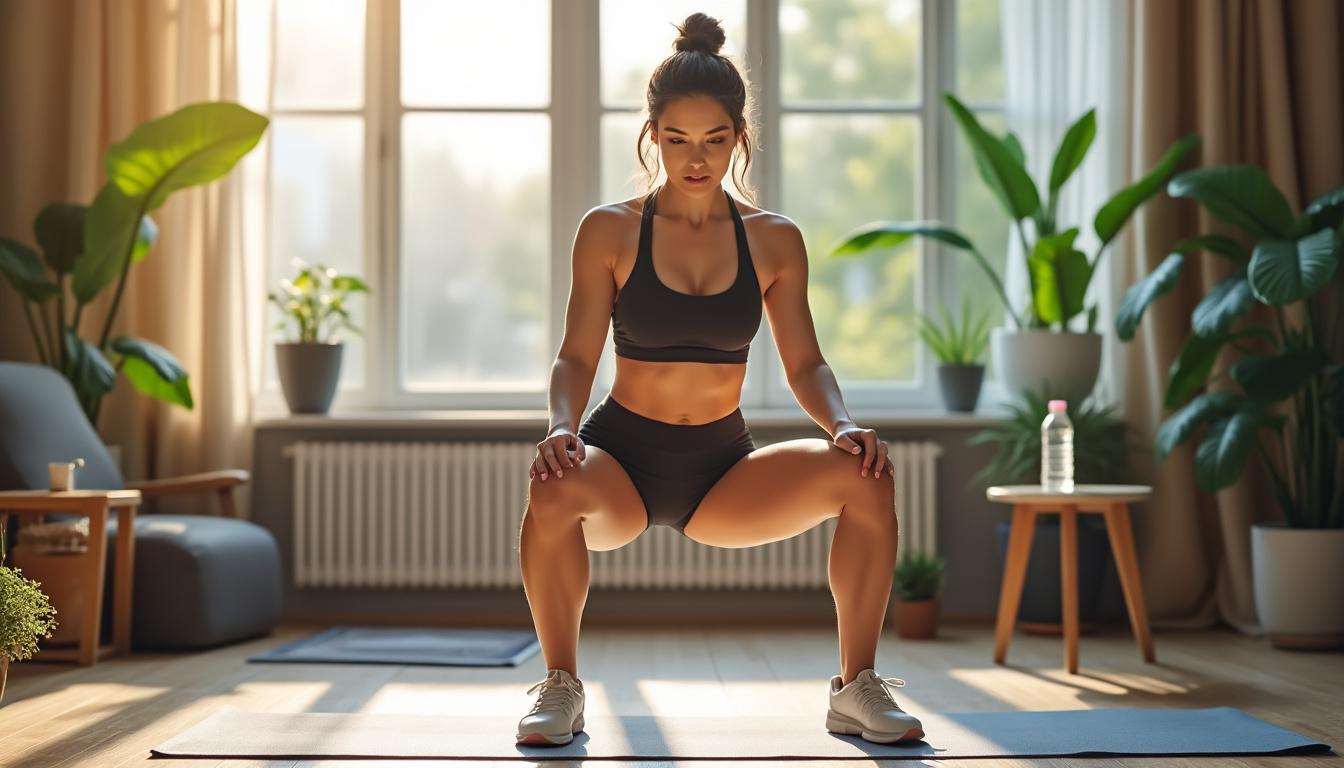
1. Classic squat
Standing position, feet shoulder-width apart. Go down by pushing your hips back until 90°, back straight. Do 3 sets of 12–20 repetitions. Variation: sumo squat to work the inner thighs and the lower part of the glutes.
2. Hip thrust
Lie on your back, knees bent, raise your pelvis by contracting your glutes until aligning shoulders-knees. 20 repetitions to isolate the gluteus maximus. Variation: lift one leg to intensify.
3. Forward lunge
Step forward, front knee at 90°, push through the heel to return. 12–15 repetitions per leg. The lunge develops balance and muscular symmetry.
4. Donkey kick
On all fours, raise the leg towards the ceiling while keeping the knee bent. 15 repetitions per leg. Ideal for sculpting the gluteus maximus.
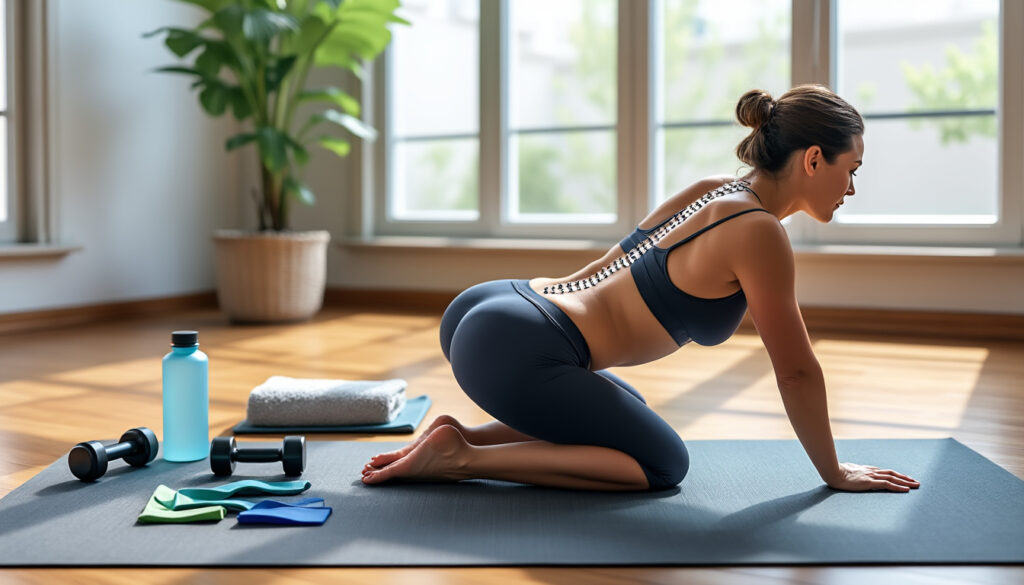
5. Fire hydrant
On all fours, lift the leg to the side, knee bent. 15–20 repetitions; excellent for the gluteus medius.
6. Step-up on chair
Place one foot on a stable chair and rise by contracting the glute. 10–12 repetitions per leg. Gentle variation: simple support to engage muscles without impact.
This video illustrates a short session ideal for replicating the above movements.
7. Skater jump
Lateral jump from one leg to the other mimicking a skater. 3 sets of 30–45 seconds. Explosive movement for tone and coordination.
8. Side leg lift
Lie on your side, lift the upper leg without tilting the pelvis. 15–20 repetitions. Useful to slim the silhouette and work the abductors.
9. Kick back standing with band
Band around ankles, push the leg back while maintaining contraction. 12–15 repetitions. Easy to integrate into a progressive workout routine.
10. Sumo squat
Feet wider apart, toes pointing outward, deep descent. 15 repetitions. Strongly engages the inner thighs and the base of the glutes.
Insight: combine isolation exercises (hip thrust, donkey kick) and compound movements (squat, lunge) for a complete workout.
Example program: mini home glute routine (toning session)
Ideal for a home gym, this circuit is performed 3 times a week. Clara executes it in 25–30 minutes during her lunch break.
| Exercise | Targeted muscles | Level | Sets / Repetitions | Equipment |
|---|---|---|---|---|
| Squat | Gluteus maximus, quadriceps | Beginner to advanced | 3 × 15 | None / dumbbell |
| Hip thrust | Gluteus maximus, hamstrings | Beginner to advanced | 3 × 20 | Mat / bench |
| Lunges | Glutes, hips | Intermediate | 3 × 12 per leg | None / bottles |
| Donkey kicks | Gluteus maximus | Beginner | 3 × 15 per leg | None / band |
| Sumo squat | Inner glutes, adductors | Intermediate | 3 × 15 | None / kettlebell |
Final tip: respect 1 minute of rest between each round to maintain a good pace and controlled intensity.
Practical tips for progressing and avoiding injuries
Progression relies on three levers: frequency, load, and quality of execution. Here are the points to prioritize for safe and effective training.
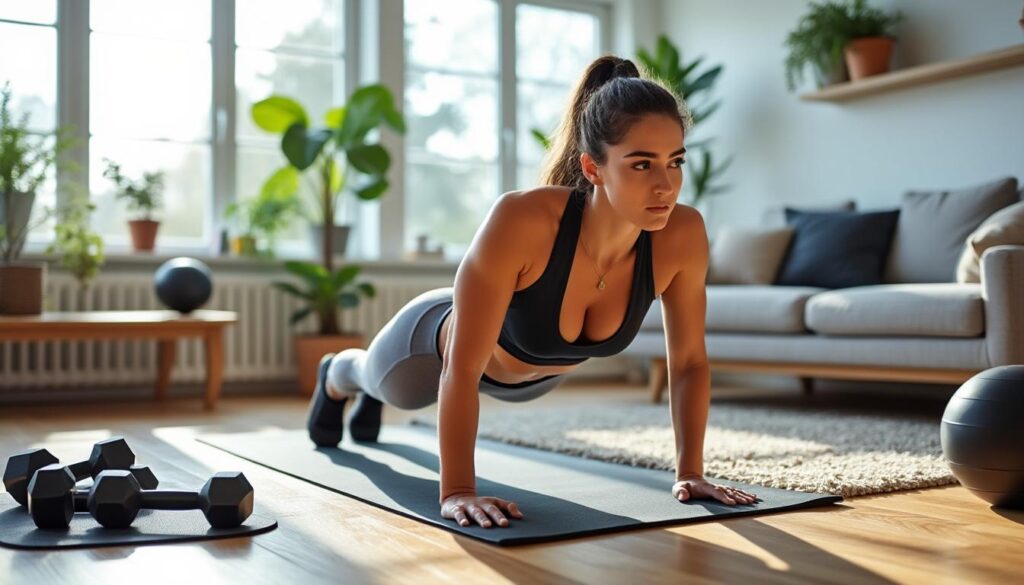
- Warm-up: 5 minutes (knee raises, butt kickers, marching in place).
- Technique: prioritize controlled movement over the number of repetitions.
- Progression: add a band or increase repetitions every 2 weeks.
- Recovery: 48 hours between two targeted glute sessions to allow the muscle to recover.
- Nutrition: ensure sufficient protein intake for muscle recovery.
Watch this video to learn about glute activation: crucial before increasing intensity.
Common mistake: arching the lower back during the hip thrust. Solution: contract the abs and maintain a controlled ascent. Insight: safety always takes precedence over performance.
Stretching and recovery after a glute toning session
After exercising, two simple stretches reduce soreness and improve mobility.
- Leg hug: lying on your back, pull your knees toward your chest for 20–30 seconds.
- Sitting twist: sitting, leg crossed, gentle rotation for 30–60 seconds per side.
Practical point: systematically integrate these stretches to preserve flexibility and reduce muscle tension.
Additional resources and inspiring programs
To vary your sessions and find clear tutorials, consult reliable guides. For example, a step-by-step program for butt exercises at home can be found in this practical guide. For very gentle alternatives doable even from the couch, this file offers clever ideas: home exercises on the couch.
Insight: diversifying sources helps maintain routine and avoid monotony.
Common mistakes and how to correct them
Some common mistakes recur often: insufficient range of motion, too rapid ascent, uneven load distribution between legs. Here’s how to correct them.
- Work on the range: squat down sufficiently without straining your knees.
- Control the speed: descend slowly and ascend by contracting.
- Correct asymmetries: include unilateral exercises like the Bulgarian squat.
Insight: consistency and body awareness replace excessive training.
Concrete examples: Clara’s guiding thread
Clara, 38, replaced two cardio sessions with poor results with 3 short targeted glute sessions per week. In four weeks, she notices better fit in her pants and less lower back pain thanks to the integration of short and progressive toning sessions.
Her tip: keep a training journal to note weights, repetitions, and feelings. Insight: tracking progress motivates and guides progression.
{« @context »: »https://schema.org », »@type »: »FAQPage », »mainEntity »:[{« @type »: »Question », »name »: »How many times a week should you do these glute exercises? », »acceptedAnswer »:{« @type »: »Answer », »text »: »The ideal is 2 to 3 sessions per week, allowing at least one rest day between each targeted workout. This allows the muscle to recover and grow stronger. »}},{« @type »: »Question », »name »: »Can you tone your glutes without equipment? », »acceptedAnswer »:{« @type »: »Answer », »text »: »Yes. Many exercises such as squats, hip thrusts, or donkey kicks can be done with body weight. However, a band or small weight can help speed up progress. »}},{« @type »: »Question », »name »: »How long does it take to see results? », »acceptedAnswer »:{« @type »: »Answer », »text »: »With consistency and proper nutrition, the first improvements in tone often appear between 4 and 6 weeks, but progress depends on your starting point and intensity. »}},{« @type »: »Question », »name »: »Do glute exercises result in localized fat loss? », »acceptedAnswer »:{« @type »: »Answer », »text »: »Exercises strengthen and shape the glute muscles, but fat loss requires a caloric deficit and cardio. It is ideal to combine strength training with regular cardio activity. »}}]}How many times a week should you do these glute exercises?
The ideal is 2 to 3 sessions per week, allowing at least one rest day between each targeted workout. This allows the muscle to recover and grow stronger.
Can you tone your glutes without equipment?
Yes. Many exercises such as squats, hip thrusts, or donkey kicks can be done with body weight. However, a band or small weight can help speed up progress.
How long does it take to see results?
With consistency and proper nutrition, the first improvements in tone often appear between 4 and 6 weeks, but progress depends on your starting point and intensity.
Do glute exercises result in localized fat loss?
Exercises strengthen and shape the glute muscles, but fat loss requires a caloric deficit and cardio. It is ideal to combine strength training with regular cardio activity.